

According to the Digital 2021* report, there are currently as many as 4.2 billion social media users worldwide. It is no wonder that social media ceases to be only a place to share life news or an area to make new acquaintances, increasingly proving to be a sales platform. Is social media for eCommerce a significant sales channel?
Social selling – a way to develop eCommerce
Social media for eCommerce sites have long been trying to diversify their revenue streams by providing sales-enhancing options that benefit online shop owners. While until recently there has been speculation about whether sites such as Facebook, Instagram or Tik Tok work well as sales venues or should be reserved solely for building brand awareness, there is now no doubt – social media channels have become the ideal sales platform.
Why? For a simple reason – the behaviour of internet users making purchases online has changed significantly. This was, of course, influenced by the pandemic, which in a way forced us to move from offline shops to online shopping. This in turn has led to a boom in social selling. What is meant by this term? In the simplest terms, social selling refers to conscious activities aimed at building a brand in social media. This includes both direct sales based on the functions provided by specific social media platforms as well as those aimed at increasing traffic to a shop’s website. Of course, this does not mean that it is enough to set up a Facebook fanpage or an Instagram profile and present a product to receive an avalanche of orders. Social selling is mainly about trust between both sides of the transaction.
The awareness of buyers has grown considerably, and so have the expectations of potential customers, who expect to receive a product that fully meets their needs in an instant and at a good price. What is more, without leaving home, they will be able to see the product they are interested in, check how it works or learn about a particular service. This is particularly desirable in the case of the so-called visual brands, which include brands for fashion, interior design, cosmetics and even gastronomy. In this case, social media channels prove invaluable. Why?
They shorten the path to purchase – for the potential buyer this is a definite advantage, and for the owner of the online shop there is less risk that the person interested in the product will decide not to buy. People making purchases via social media channels most often make decisions spontaneously and buy under the influence of emotions.
Make it possible to precisely define the target group – regular activity, naturalness of the message, presenting the product in an attractive, “non-salesy”, but more “human” way and practically unlimited remarketing possibilities may turn out to be a more effective and cheaper alternative to SEO, and certainly to offline activities
Provide greater comfort to the buyer – appropriate targeting reduces the risk that our message and communication about a product or service will reach a person who does not belong to our target – this not only reduces the risk of exposing ourselves to additional costs and burning through the budget, but also saves recipients from a crowd of unwanted ads that can drive them crazy. An appropriate message, which in social media is first and foremost a visually attractive post or video, and only then a sales offer, is something which is more attractive for recipients than a typical “buy” message. Social media channels also allow for a natural presentation of the product in such a way that the user can check how the item performs in everyday use, how it composes with other elements of clothing or home furnishings – thanks to this the recipient does not have the feeling that they are watching another advertisement, but a presentation of a product that will meet all their expectations, minimising the risk of disappointment after purchase.
Increasingly popular is the sale during a live broadcast, which is not only something attractive in terms of form, but also a great way to engage users and build a relationship with each other, which, as already mentioned, is extremely important for consumers. We also cannot forget about the convenience of the shopper, who does not have to move from his couch to purchase the products he is interested in. It is estimated that on average, users spend as much as 2 hours and 25 minutes a day on social media, which means that they save some time – if they spend their time scrolling on Facebook, Instagram or TikTok, and at the same time they can buy the products they need, they can kill two birds with one stone! The report The power of social & live commerce shows that 64% of the population surveyed confirm that they are happy to shop via social media for eCommerce channels for reasons of convenience, 41% of respondents paid attention to the matching of offers. Other factors influencing the acceleration of the purchase decision were attractive prices, discounts or rebates, which had more value for women, who are statistically more prone to bargains**.
Possibilities of social media for eCommerce – what functionalities do social platforms for eCommerce offer?
From the previous part of the article, it can be concluded that social media is appreciated by users who willingly spend their free time observing their favourite brands and discovering new ones that offer products and services that meet their needs or interests. However, what do social media channels actually have to offer to people who want to increase conversion in their eCommerce?
Call to Action in Facebook posts – a call to action. The effectiveness of this type of post depends not only on what is on the graphic, but also on the content of the message on the bar below it. The message should therefore be clear and simple, the recipient must know what will gain by clicking on the post. Facebook offers several options, including CTA suggesting the possibility of making a reservation, planning a visit, contact via Messenger, phone or email, download the application, go to the website to get more information on a given topic, make a purchase or check other offers, e.g. related to the product presented in the graphic.

Source: https://www.facebook.com/
Instagram with a shopping feature – Instagram is undoubtedly one of the most engaging social media outlets. The platform not only allows you to add product tags in posts or reports, but also offers the “Store” tab, where the user has the opportunity to obtain additional data about the product, know the price or view the full offer of the company and go to the store’s website with one click.
 Source: https://www.instagram.com/

Source: https://www.instagram.com/
Brand takeover and advertising campaigns on TikTok – if your e-store offers products or services for the Z generation, TikTok is a tool that should be the basis of your marketing activities. The brand takeover option allows you to present your ad directly after launching the application, allowing you to go to a site where you can make a purchase.
It is a 5-second, full-screen creative or video material that appears to all users after starting the application. It is quite an expensive solution, but extremely effective. If you want to use other possibilities of the application, it is worth remembering that TikTok users are young people who get bored quickly, so they prefer, for example, a short 10-second native video with the product – here the In-Feed Ads format will be useful – the advertisement displays in the “For You” tab and has the form of a video lasting from 10 to 15 seconds with the possibility of adding a CTA.
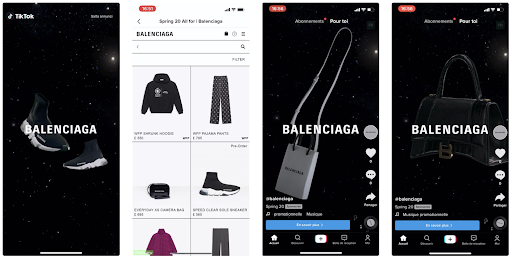
Source: https://www.tiktok.com/
As you can see, social media for eCommerce gives sellers a lot of possibilities. In the era of changing the Facebook and Instagram algorithm, it is announced that new functionalities will be introduced gradually, which are to additionally improve the process of social selling.
social media for eCommerce – a way to increase traffic on the site
Including social media for eCommerce channels in your marketing strategy is not only a way to reach a larger number of recipients and increase profits, but also a field to increase website traffic and build brand awareness and user ties with the company. How? Both the fanpage on Facebook and the profile on Instagram make it possible to blur the boundaries between buyers perceived only as a source of potential income and a company that offers specific goods, allowing consumers to “fraternise” with sellers. Building relationships with your audience is an extremely important point on the way to the success of your online store.
In addition to creating dedicated campaigns and attractive posts, you can easily invite recipients to “co-create” your brand. I do not mean working with influencers (this is, of course, a great way to advertise and increase website traffic, but not everyone can afford this form due to the high costs), but entering into a direct relationship with buyers. Do you run a company blog? You certainly want to encourage observers to visit it. Replace the classic message “we invite you to read” with the message “create a blog with us” – it is a great solution not only to get to know the needs of the recipients and better tailor activities to translate into an increase in conversion or finding inspiration for new articles, but also building in awareness of the recipients of the belief that they are important for the brand, that their interests or needs are taken into account and prioritised. By creating a survey in an Instagram report or a dedicated post on Facebook with a question about what they would like to read on the blog, you gain a greater probability that readers will be more likely to return to the website, thus extending the session time, visiting the blog regularly and reading the content in detail, what will appear there.
Summary
At the same time, remember not to be intrusive – consumers are more and more sensitive to clickbaits and direct calls to shopping or visiting the store’s website. A much better and more effective form will be to prepare engaging posts with an understatement. What does this mean in practice? For example, when running a grocery store, you can eat a recipe – recipients encouraged by an interesting, tasty-sounding recipe will be more likely to visit the store’s website to be able to complete the necessary products to prepare the dish. Do you run a jewellery store? Present an interesting style on the graphics and encourage the recipients to complete the accessories, referring them to a specific product category. Are you the owner of an online store offering layettes for children? Instead of creating a message “buy essential products for a baby”, invite users to read the latest blog article, where you share tips on how to complete a layette for a newborn, including specific product proposals in the text.
*https://datareportal.com/reports/digital-2021-global-overview-report
**https://www.kobietyebiznesu.pl/wp-content/uploads/2021/06/Raport-social-live-commerce-Fundacja-Kobiety-e-biznesu.pdf
