

Scrum, as an agile project management methodology, does not impose management techniques on the project team, but allows the team to self-organise. One of the most important elements of Scrum is the Backlog, which best illustrates the scope of work for a given sprint. It should be emphasised that the Scrum Guide does not define what the workflow should look like, so to complement the agile management methodology, a kanban board is most often used as an addition. It is a board divided into at least 3 sections. (To Do, In Progress, Done) between which specific tasks in the sprint are shifted.
History kanban board
The original kanban system was established in 1947 by Taiichi Ohno, an employee of the Japanese company Toyota Motor Corporation. One of the reasons was the company’s insufficient productivity compared to its US competitors. Ohno described the idea as follows:
“It should be possible to organise the flow of materials in production according to the supermarket principle, i.e. the consumer takes a certain amount of product from the shelf and the gap is immediately filled”.
The word Kanban from Japanese means a signboard or a plate with an informative text. It is a production control method, the most important element of which is inventory control – each organisational unit should produce only as much goods as is currently needed. The purpose of the method is to reduce inventories, their storage costs, eliminate production downtime, and ultimately increase the productivity of the entire enterprise.
How to connect a Kanban board with Scrum
As mentioned above, scrum does not define a workflow by definition, so a Kanban table is used as a complement. The greatest advantage of the Kanaban board is the flow visualisation. The first column is the project’s backlog that is prepared at the beginning of the sprint. The minimum number of columns is 3 (to do, in progress, done), for more complex projects you can add new columns, such as testing or deploy.
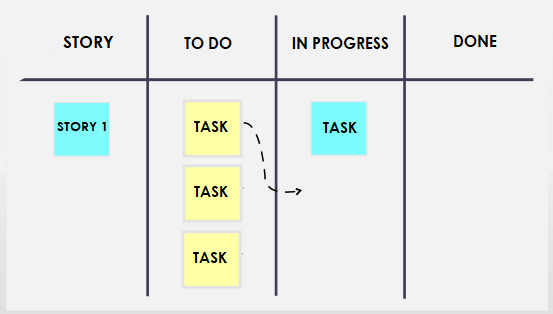
Workflow management in a sprint
Flow visualisation is used to eliminate bottlenecks. Apart from the columns themselves, there should be a number above each of them that reflects the maximum number of tasks that can be in one column at the same time. These numbers are intended to reduce the tasks in the flow and to make it easier to identify bottlenecks.
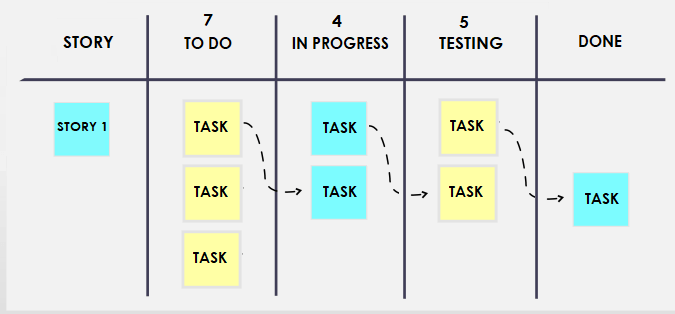
Thanks to the use of columns and numbers with the maximum number of tasks, we are able to measure the flow of work, bottlenecks and constantly monitor the process. Bottlenecks cannot be completely removed in the development process. However, easier monitoring of them allows for more effective management of them during development. For example, if the number of cards in the testing column exceeds the predetermined number of 5, it is a signal with a potential bottleneck at the testing stage.
Therefore, it will be necessary to verify the work of testers or additional recruitment for the position of a tester. Checkpoints are used to catch bottlenecks. However, it should be remembered that bottlenecks will always appear. In the case of software development, it is virtually impossible to prepare a 100% reliable process. Daily stand-ups, accurate planning, retrospective and adherence to the scrum definition based on trust and “equality” of team members help in capturing threats and problems.
Summary
Kanban board with Scrum works very well in software development and has now become a standard in IT. The kanban board allows you to visualise the process of work and information flow. It is important for the team and the individual members of the team that the process moves forward. The team sees gains, threats or shortcomings and is able to react and manage them in time. If you want to know what a kanban board is in more detail, see the Wikipedia page for more information.
See also categories: Social Media in eCommerce | PPC Campaigns | Shopify technologies | eCommerce SEO | E-mail marketing | eCommerce project management | eCommerce marketing | eCommerce management | eCommerce development | eCommerce b2b | eCommerce automation | eCommerce analytics | Content marketing | Case Study eCommerce | News | Other
